
Why do local building codes matter for a roof?
Local building codes establish minimum safety requirements for roof construction, replacement, repair, ventilation, insulation, drainage, and structural support. In East Syracuse, NY, these requirements are especially relevant because roofs must withstand heavy snow, freezing temperatures, ice formation, wind, and repeated winter-to-spring moisture cycles.
A roof can appear sound from the ground and still have problems that affect structural safety or code compliance. Building codes help address risks that are not always visible, including inadequate roof framing, overloaded structures, improper flashing, poor ventilation, and unsafe layers of old roofing material.
Codes are not intended to dictate every design choice. They set a baseline so that roofing work performs safely under expected local conditions.
Which building codes apply to roofing work?
Roofing projects in this area generally fall under New York State’s Uniform Code and Energy Code, along with local rules for permits, inspections, and enforcement. New York’s updated 2025 Uniform Code and Energy Code became effective for new permit applications on December 31, 2025.
The exact requirements depend on the project. A simple replacement of roof covering may be treated differently from work that changes roof framing, adds insulation, alters ventilation, installs skylights, or supports solar equipment.
The applicable rules may address:
- Structural design and roof-load capacity
- Snow and ice loads
- Wind resistance and attachment methods
- Underlayment and weather protection
- Flashing around chimneys, walls, valleys, and penetrations
- Roof drainage and water-shedding details
- Attic insulation and ventilation
- Fire classification of roofing materials
- Safe access and inspection requirements
- Electrical or structural provisions for rooftop equipment
The code in effect may depend on when the permit application is submitted, not simply on when the house was built.
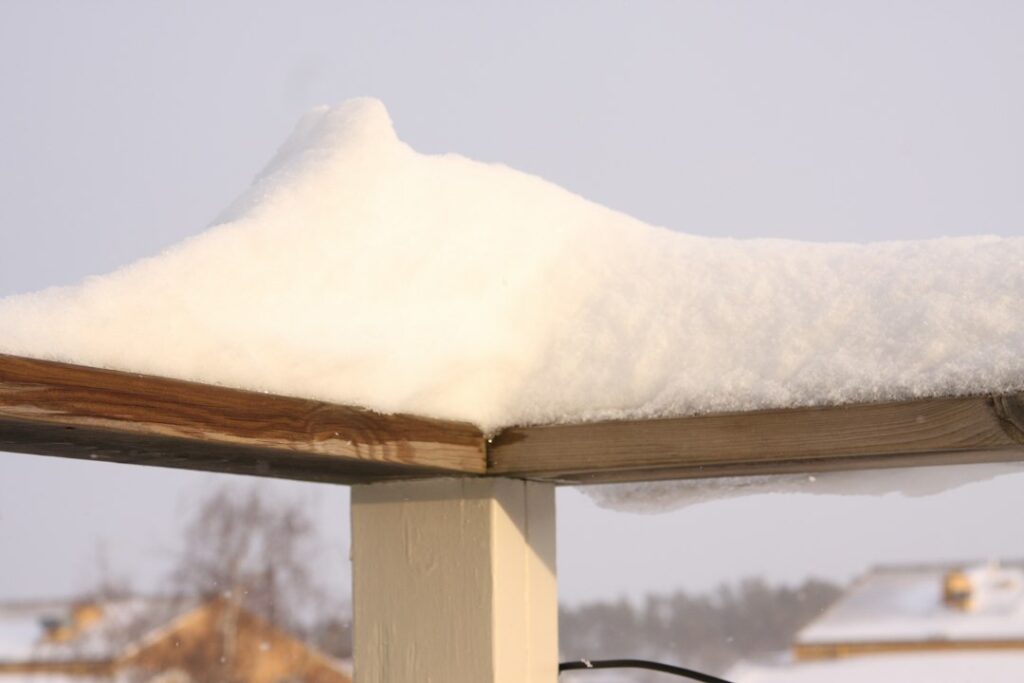
How do snow loads affect a roof in East Syracuse?
Snow load requirements help determine whether roof framing can safely support accumulated snow and related forces. The design considers more than the weight of a single snowfall. It can also account for drifting, uneven accumulation, roof shape, slope, exposure, and snow collecting against higher sections of a building.
The 2025 New York residential code requires roof design to account for the applicable live load or ground snow load, whichever produces the greater design requirement. This is one reason a roof that performed adequately for decades may still need careful evaluation when major structural changes are proposed.
Several conditions can increase concern:
- A low-slope roof where snow remains in place
- Roof sections at different elevations
- Valleys where snow and ice collect
- Additions attached to older structures
- Sagging rafters, trusses, or ceiling members
- Heavy rooftop equipment or solar installations
- Multiple layers of existing roofing material
Snow-related code requirements do not mean every roof must be redesigned after every storm. They do mean that structural capacity should not be assumed when a project adds weight, changes framing, or exposes previously concealed damage.
Does replacing shingles require a building permit?
A permit may be required, depending on the scope of work and local administration. In East Syracuse, building regulations generally require an approved permit before work that must comply with the Uniform Code or Energy Code begins, unless a specific exemption applies.
Homeowners should not assume that “just replacing shingles” is automatically exempt. Requirements can vary based on whether the work involves only the roof covering or also includes sheathing, structural repairs, insulation, ventilation, skylights, chimneys, or other building systems.
A permit application may require a description of the work and construction documents detailed enough to show compliance. The local code enforcement office determines which documents and inspections apply to a particular project.
Permit questions are worth resolving before materials are removed. Beginning work first can create delays, additional costs, or problems documenting that the completed work meets code.
What happens if damaged roof decking is found?
Roof decking, also called roof sheathing, provides the surface to which many roof coverings are attached. If it is weakened by rot, prolonged leakage, or snow-related stress, installing new shingles over it may not produce a safe or durable roof.

Once decking is exposed, the project may change from a straightforward covering replacement to a repair involving structural or moisture-damaged components. The extent of the damage should be documented, and any changes from the approved scope may need to be reported to the code enforcement office.
This is also where older houses require careful attention. Existing buildings are generally not required to meet every current provision simply because a newer code has been adopted. However, new work typically must comply with the requirements that apply to that work, and unsafe conditions cannot be ignored.
How do ventilation and insulation rules affect roofing?
Roofing codes and energy codes address more than the exterior shingles. Attic insulation, air sealing, and ventilation affect moisture control, winter heat loss, ice formation, and the life of roof materials.
Poorly balanced ventilation can allow warm, moist air to reach the underside of the roof deck. That moisture may condense during cold weather and contribute to mold, wood deterioration, or wet insulation. Excess heat escaping into the attic can also contribute to uneven snow melt and ice formation along colder roof edges.
A reroofing project may reveal that insulation or ventilation changes are needed. The current energy requirements may apply to altered portions of the building, while existing, unaltered areas may be treated differently. Special technical rules can apply when adding insulation could create an unsafe structural condition or overload an existing roof assembly.
The practical question is not simply whether a roof has enough vents. The system should allow air movement where intended, limit uncontrolled air leakage from the living space, and avoid blocking soffit or ridge ventilation with insulation.
Are local rules stricter than the state code?
New York’s Uniform Code applies statewide outside areas with separate code authority, but local governments may adopt certain standards that are more restrictive than the state minimum when authorized by law. Local administration can also affect permit forms, fees, inspection scheduling, required documents, and enforcement procedures.
That means two projects with similar materials may not follow exactly the same administrative process. The building’s location, use, age, construction type, and project scope can all affect what is required.
Local zoning rules may also matter when a project changes the roof’s height, shape, equipment, drainage pattern, or relationship to property boundaries. Building-code approval and zoning approval are separate issues, and one does not automatically replace the other.
What should homeowners ask before roofing work begins?
A short set of questions can prevent misunderstandings:
- Is a building permit required for the planned scope?
- Which code edition applies to the permit application?
- Will the roof deck, framing, insulation, or ventilation be altered?
- Are multiple layers of roofing already present?
- What snow-load or structural concerns apply to the roof?
- Which inspections are required, and at what stages?
- What happens if concealed damage is discovered?
- Are skylights, chimneys, solar equipment, or other penetrations included?
- Does the project affect drainage or runoff?
- Will the final work be documented in the property records?
These questions are particularly useful before winter or during spring repairs, when roof damage may be concealed by snow, ice, or temporary coverings.
Building codes cannot prevent every leak or storm-related problem. They do provide a framework for evaluating whether a roof is designed, repaired, and altered with the local climate and the building’s structural limits in mind. For area households, understanding those requirements is part of protecting the roof, the attic, and the living space below it.
